When it comes to executive recruitment, everyone talks about “growing leaders from within.”
That is, until the internal promotion tanks six months later and the whole department’s on fire.
The truth is, leadership hiring isn’t about loyalty or luck. It’s about perspective—and that’s exactly what most companies lose when they only look inward.
Which is why, in this article, we’re unpacking what really separates internal promotions from external executive recruitment—when each approach makes sense, where companies go wrong, and how to make leadership decisions that actually stick.
Let’s get into it.
1. What Makes Executive Recruitment Different From Standard Hiring or Internal Promotions?
Executive recruitment is often considered “hiring, but fancier”, but the truth is, it’s a fundamentally different beast.
For instance, when you’re hiring a junior developer, you can afford to take some risks. They mess up—the damage is contained.
But executives? They set strategic direction. They shape culture. They influence whether your best people stay or bolt for the competition.
That’s why internal teams—no matter how talented—are sometimes not the best fit for executive recruitment, due to being stuck with a limited view. They see candidates through the lens of office politics, personal loyalties, and who showed up to the company holiday party.
That’s also why internal promotions are a minefield of bias.
Affinity bias makes managers gravitate toward people who remind them of themselves—same background, same communication style, same hobbies. The halo effect means one impressive trait overshadows everything else.
Now, external recruiters like People Focus operate differently from this. For starters, we measure candidates against the data, not just against whoever happens to already work for you or your gut feeling.
We are able to do this thanks to our detailed recruitment request forms, our structured assessments, and market benchmarking.
Again, no “gut feelings.” No “we just clicked.” Just competencies, cultural fit based on actual behavioral patterns, and performance indicators that predict long-term success.
For instance, our detailed recruitment request form digs into things most companies overlook:
team structure,
communication style,
personality traits that thrive in your specific organization, and
what a candidate’s actual day-to-day will look like.
This makes all the difference between hiring someone who looks good on paper and hiring someone who’ll still be crushing it in five years.
Then, there’s our executive recruitment screening process, which involves reviewing hundreds—sometimes thousands—of LinkedIn profiles (many incomplete or outdated), conducting dozens of screening interviews in just days, and sussing out the stuff you can’t see on a resume:
Is this person actively looking?
What are their real salary expectations?
Do they want remote or office work?
What actually motivates them?.
And lastly, we bring in the data you don’t have internally. Info on things like:
What are top candidates in this role actually asking for in the current market?
What’s realistic for your budget?
Where are the gaps in your expectations?
All of this, alongside having a CEO who’s got 20+ years of DACH-region IT experience, makes 3rd-party executive recruitment a much better choice than internal promotions.
2. When Is Executive Recruitment Via Third Party Recruiters Smarter Option?
Simple answer: Executive recruitment is your best bet when you can’t afford to waste time or money on the wrong hire.
If your internal HR team is drowning in payroll, employee development, compliance, retention strategies, and oh yeah—trying to find your next executive in their spare time—you’re not going to have a fun time.
Why?
Because for a junior role, you might get 300 applications in a week. For a senior executive role? Maybe three lukewarm CVs in three months.
The matter of fact is: Top candidates aren’t sitting around waiting for your job post. They’re already employed, heads-down in projects, and definitely not checking LinkedIn.
In fact, 70% of the global IT workforce is passive talent. They’re not “looking,” but they’re open to the right conversation.
Well, People Focus IT recruitment agency in Serbia flips that script with our network of 4,000+ vetted IT professionals that fit right into that category. And we’re not talking just resumes—we’re talking actual relationships built over years.
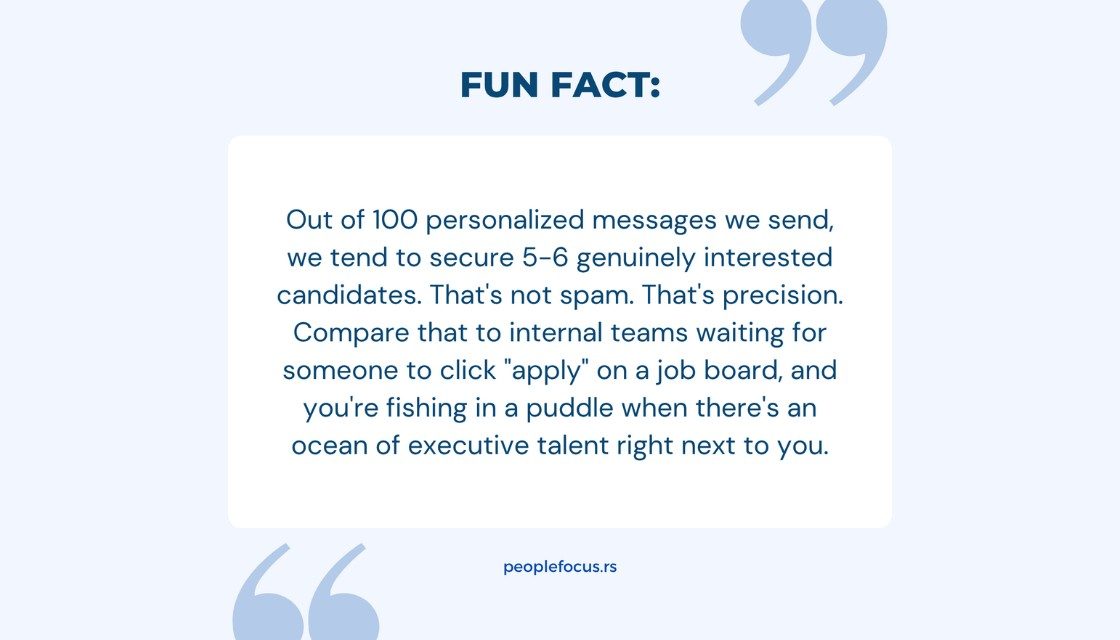
When we reach out (and we never rely on just posting job ads and hoping the unicorn candidate will click ‘apply’!), candidates pick up the phone. When your HR team sends a cold email, it goes to spam.
Executive Search People Focus
3. When Is The Internal Promotion Of An Executive A Smarter Option?
It is true that external executive recruitment isn’t always the answer.
If you’re hiring constantly—dozens or hundreds of people a year—building an internal recruitment team makes sense. The upfront investment pays off when you have predictable, high-volume hiring needs.
Internal promotions work beautifully when:
You’re filling repetitive roles where the sourcing process can be standardized.
You already have the right tools (LinkedIn Recruiter, ATS, testing platforms) and the hiring volume to justify those costs.
The promoted employee deeply understands your culture, operations, and long-term strategy.
Internal candidates hit the ground running. They already know your systems, your team dynamics, and your unspoken norms. There’s no lengthy onboarding. No “learning the ropes.” They’re productive from day one.
And let’s be honest—promoting from within sends a powerful message to your workforce. It shows that loyalty and hard work are valued and rewarded.
So when you have someone internally who’s proven themselves, fits your culture, and is genuinely ready for the next level? Promote them.
But—and this is critical—only if you’ve done the work to objectively assess their readiness, like People Focus does when executive recruitment is concerned.
4. What Are The Risks Of The Internal Executive Promotion?
Here’s where companies often mess up: they promote someone because it “feels right” without doing the hard work of external benchmarking.
Why does this happen? Often because internal teams struggle with objective assessment, and that’s because they’re too close to the situation. They see the candidate through years of shared experiences, office friendships, and that time they pulled an all-nighter to save a project.
But can this person actually lead at the executive level? Do they have the strategic thinking, the decision-making under pressure, the ability to manage cross-functional teams?
Without external benchmarking, you have no idea how they stack up against the broader market.
People Focus forces that comparison during our executive recruitment process. We show companies: “Here’s what top executive talent looks like. Here’s what they’re capable of. Here’s how your internal candidate measures up.”
Sometimes the internal candidate is great. Sometimes they’re not ready yet. But at least you’re making the decision with full information.
Another risk is associated with a scenario when employees don’t understand the reasoning behind promotion decisions. In cases like those, they assume favoritism. And honestly? They’re often right.
Managers gravitate toward people who remind them of themselves (affinity bias), people who are visible and charismatic (halo effect), and people who’ve been loyal soldiers even if they’re not ready to lead.
This leads to resentment, disengagement, and ultimately weaker leadership pipelines—all because decisions were made on gut feeling instead of grounded evaluation.
Overall, when internal promotions are made too quickly, issues arise fairly quickly.
Six months in, the promoted executive starts struggling. Projects are delayed. The team is frustrated. Key performers start looking elsewhere.
And now the company faces a brutal choice: stick with the struggling executive (and watch performance crater) or admit the mistake and restart the search.
5. What Is The ROI Of External Executive Recruitment?
Let’s talk numbers associated with external executive recruitment, shall we?
The facts say that companies report an average 191% return on investment from HR outsourcing, and People Focus tracks.
Here’s what our stats show:
When you hire us for executive recruitment, instead of spending 20-30 hours screening 250 CVs down to a shortlist, you get 3-5 pre-vetted candidates within the first week. That’s 20 hours of your team’s time back—time they can spend on actual strategic work.
A full-time internal recruiter in Germany costs €50,000-55,000 per year, plus another €10,000-20,000 for recruitment software, job board subscriptions, and LinkedIn licenses. With People Focus, you only pay for results when you need them.
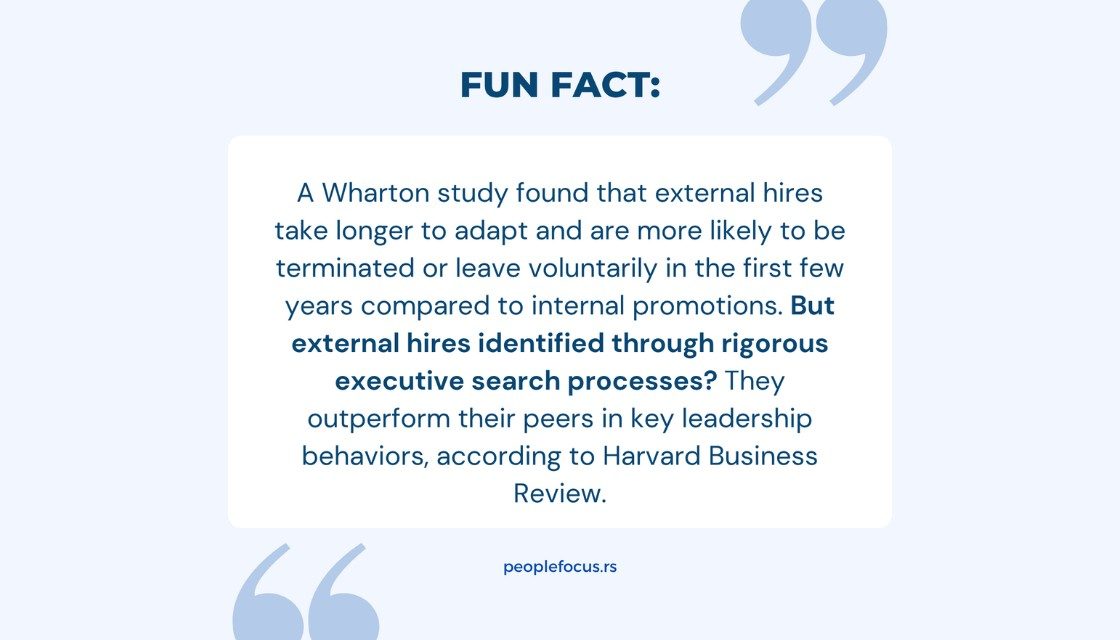
People Focus candidates stay 10+ years. Some professionals their CEO placed over a decade ago are still with those companies today. Compare that to internal hires who often leave within a year or two. We’re big on retention rates.
Early turnover is brutal. When it comes to hiring in Germany and Austria, replacing a specialist within the first year costs €30,000-60,000. Even a mid-level role that fails early can cost €15,000-25,000 to replace. People Focus executive recruitment helps companies avoid those costs entirely with our 3-month replacement guarantee.
Executive Recruitment Bullseye Hit
Overall, the executive recruitment process makes all the difference.
And when you promote internally without proper assessment, you’re gambling. When you work with specialized executive recruiters like People Focus, who vet for both technical skills and cultural fit, you’re making an informed investment.
6. How Does The Collaboration Between External Executive Recruiters And Internal Teams Look Like?
The best executive recruitment isn’t recruiters doing their thing in isolation. It’s a partnership.
People Focus is not just sending you resumes and disappearing. We operate as an extension of your internal team.
Before the search, we sit down with your leadership team to understand not just the job description, but also the team dynamics, company culture, communication style, and what success actually looks like in this role.
During the search, we handle all the heavy lifting—screening hundreds of profiles, conducting initial HR interviews, assessing cultural and technical fit, and delivering only the 3-5 candidates who are genuinely qualified.
We also manage feedback loops, giving candidates clear, constructive responses so no one gets ghosted. This protects your employer reputation while keeping candidates engaged.
After placement, we check in to ensure the hire is thriving. And if something goes wrong within the first three months? We restart the search at no extra cost.
So, as you can see, successful collaboration for us means you’re not getting generic candidates who “might work.” You’re getting candidates who fit.
Ready to stop gambling on internal promotions and start building a leadership team that actually lasts? Contact us to learn more about our external executive recruitment service.
When it comes to executive recruitment, everyone talks about “growing leaders from within.”
That is, until the internal promotion tanks six months later and the whole department’s on fire.
The truth is, leadership hiring isn’t about loyalty or luck. It’s about perspective—and that’s exactly what most companies lose when they only look inward.
Which is why, in this article, we’re unpacking what really separates internal promotions from external executive recruitment—when each approach makes sense, where companies go wrong, and how to make leadership decisions that actually stick.
Let’s get into it.
1. What Makes Executive Recruitment Different From Standard Hiring or Internal Promotions?
Executive recruitment is often considered “hiring, but fancier”, but the truth is, it’s a fundamentally different beast.
For instance, when you’re hiring a junior developer, you can afford to take some risks. They mess up—the damage is contained.
But executives? They set strategic direction. They shape culture. They influence whether your best people stay or bolt for the competition.
That’s why internal teams—no matter how talented—are sometimes not the best fit for executive recruitment, due to being stuck with a limited view. They see candidates through the lens of office politics, personal loyalties, and who showed up to the company holiday party.
That’s also why internal promotions are a minefield of bias.
Affinity bias makes managers gravitate toward people who remind them of themselves—same background, same communication style, same hobbies. The halo effect means one impressive trait overshadows everything else.
Now, external recruiters like People Focus operate differently from this. For starters, we measure candidates against the data, not just against whoever happens to already work for you or your gut feeling.
We are able to do this thanks to our detailed recruitment request forms, our structured assessments, and market benchmarking.
Again, no “gut feelings.” No “we just clicked.” Just competencies, cultural fit based on actual behavioral patterns, and performance indicators that predict long-term success.
For instance, our detailed recruitment request form digs into things most companies overlook:
team structure,
communication style,
personality traits that thrive in your specific organization, and
what a candidate’s actual day-to-day will look like.
This makes all the difference between hiring someone who looks good on paper and hiring someone who’ll still be crushing it in five years.
Then, there’s our executive recruitment screening process, which involves reviewing hundreds—sometimes thousands—of LinkedIn profiles (many incomplete or outdated), conducting dozens of screening interviews in just days, and sussing out the stuff you can’t see on a resume:
Is this person actively looking?
What are their real salary expectations?
Do they want remote or office work?
What actually motivates them?.
And lastly, we bring in the data you don’t have internally. Info on things like:
What are top candidates in this role actually asking for in the current market?
What’s realistic for your budget?
Where are the gaps in your expectations?
All of this, alongside having a CEO who’s got 20+ years of DACH-region IT experience, makes 3rd-party executive recruitment a much better choice than internal promotions.
2. When Is Executive Recruitment Via Third Party Recruiters Smarter Option?
Simple answer: Executive recruitment is your best bet when you can’t afford to waste time or money on the wrong hire.
If your internal HR team is drowning in payroll, employee development, compliance, retention strategies, and oh yeah—trying to find your next executive in their spare time—you’re not going to have a fun time.
Why?
Because for a junior role, you might get 300 applications in a week. For a senior executive role? Maybe three lukewarm CVs in three months.
The matter of fact is: Top candidates aren’t sitting around waiting for your job post. They’re already employed, heads-down in projects, and definitely not checking LinkedIn.
In fact, 70% of the global IT workforce is passive talent. They’re not “looking,” but they’re open to the right conversation.
Well, People Focus IT recruitment agency in Serbia flips that script with our network of 4,000+ vetted IT professionals that fit right into that category. And we’re not talking just resumes—we’re talking actual relationships built over years.
When we reach out (and we never rely on just posting job ads and hoping the unicorn candidate will click ‘apply’!), candidates pick up the phone. When your HR team sends a cold email, it goes to spam.
Executive Search People Focus
3. When Is The Internal Promotion Of An Executive A Smarter Option?
It is true that external executive recruitment isn’t always the answer.
If you’re hiring constantly—dozens or hundreds of people a year—building an internal recruitment team makes sense. The upfront investment pays off when you have predictable, high-volume hiring needs.
Internal promotions work beautifully when:
You’re filling repetitive roles where the sourcing process can be standardized.
You already have the right tools (LinkedIn Recruiter, ATS, testing platforms) and the hiring volume to justify those costs.
The promoted employee deeply understands your culture, operations, and long-term strategy.
Internal candidates hit the ground running. They already know your systems, your team dynamics, and your unspoken norms. There’s no lengthy onboarding. No “learning the ropes.” They’re productive from day one.
And let’s be honest—promoting from within sends a powerful message to your workforce. It shows that loyalty and hard work are valued and rewarded.
So when you have someone internally who’s proven themselves, fits your culture, and is genuinely ready for the next level? Promote them.
But—and this is critical—only if you’ve done the work to objectively assess their readiness, like People Focus does when executive recruitment is concerned.
4. What Are The Risks Of The Internal Executive Promotion?
Here’s where companies often mess up: they promote someone because it “feels right” without doing the hard work of external benchmarking.
Why does this happen? Often because internal teams struggle with objective assessment, and that’s because they’re too close to the situation. They see the candidate through years of shared experiences, office friendships, and that time they pulled an all-nighter to save a project.
But can this person actually lead at the executive level? Do they have the strategic thinking, the decision-making under pressure, the ability to manage cross-functional teams?
Without external benchmarking, you have no idea how they stack up against the broader market.
People Focus forces that comparison during our executive recruitment process. We show companies: “Here’s what top executive talent looks like. Here’s what they’re capable of. Here’s how your internal candidate measures up.”
Sometimes the internal candidate is great. Sometimes they’re not ready yet. But at least you’re making the decision with full information.
Another risk is associated with a scenario when employees don’t understand the reasoning behind promotion decisions. In cases like those, they assume favoritism. And honestly? They’re often right.
Managers gravitate toward people who remind them of themselves (affinity bias), people who are visible and charismatic (halo effect), and people who’ve been loyal soldiers even if they’re not ready to lead.
This leads to resentment, disengagement, and ultimately weaker leadership pipelines—all because decisions were made on gut feeling instead of grounded evaluation.
Overall, when internal promotions are made too quickly, issues arise fairly quickly.
Six months in, the promoted executive starts struggling. Projects are delayed. The team is frustrated. Key performers start looking elsewhere.
And now the company faces a brutal choice: stick with the struggling executive (and watch performance crater) or admit the mistake and restart the search.
5. What Is The ROI Of External Executive Recruitment?
Let’s talk numbers associated with external executive recruitment, shall we?
The facts say that companies report an average 191% return on investment from HR outsourcing, and People Focus tracks.
Here’s what our stats show:
When you hire us for executive recruitment, instead of spending 20-30 hours screening 250 CVs down to a shortlist, you get 3-5 pre-vetted candidates within the first week. That’s 20 hours of your team’s time back—time they can spend on actual strategic work.
A full-time internal recruiter in Germany costs €50,000-55,000 per year, plus another €10,000-20,000 for recruitment software, job board subscriptions, and LinkedIn licenses. With People Focus, you only pay for results when you need them.
People Focus candidates stay 10+ years. Some professionals their CEO placed over a decade ago are still with those companies today. Compare that to internal hires who often leave within a year or two. We’re big on retention rates.
Early turnover is brutal. When it comes to hiring in Germany and Austria, replacing a specialist within the first year costs €30,000-60,000. Even a mid-level role that fails early can cost €15,000-25,000 to replace. People Focus executive recruitment helps companies avoid those costs entirely with our 3-month replacement guarantee.
Executive Recruitment Bullseye Hit
Overall, the executive recruitment process makes all the difference.
And when you promote internally without proper assessment, you’re gambling. When you work with specialized executive recruiters like People Focus, who vet for both technical skills and cultural fit, you’re making an informed investment.
6. How Does The Collaboration Between External Executive Recruiters And Internal Teams Look Like?
The best executive recruitment isn’t recruiters doing their thing in isolation. It’s a partnership.
People Focus is not just sending you resumes and disappearing. We operate as an extension of your internal team.
Before the search, we sit down with your leadership team to understand not just the job description, but also the team dynamics, company culture, communication style, and what success actually looks like in this role.
During the search, we handle all the heavy lifting—screening hundreds of profiles, conducting initial HR interviews, assessing cultural and technical fit, and delivering only the 3-5 candidates who are genuinely qualified.
We also manage feedback loops, giving candidates clear, constructive responses so no one gets ghosted. This protects your employer reputation while keeping candidates engaged.
After placement, we check in to ensure the hire is thriving. And if something goes wrong within the first three months? We restart the search at no extra cost.
So, as you can see, successful collaboration for us means you’re not getting generic candidates who “might work.” You’re getting candidates who fit.
Ready to stop gambling on internal promotions and start building a leadership team that actually lasts? Contact us to learn more about our external executive recruitment service.